
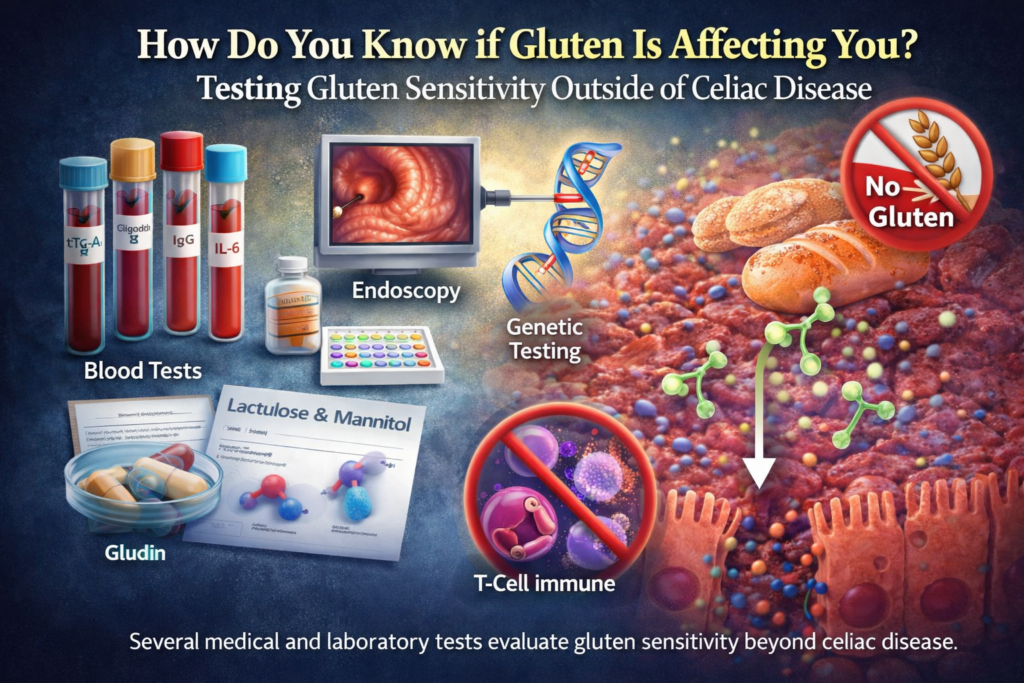
Gluten Sensitivity Test: How Do You Know If Gluten Is Affecting You?
Testing Gluten Sensitivity Outside of Celiac Disease
Throughout this series we have explored several questions about gluten. We began by asking what gluten actually is and why it affects people differently. We then looked at differences between wheat products in the United States and Europe. Finally, we examined the biological mechanisms involving zonulin and intestinal permeability that may contribute to immune activation in certain individuals.
All of this naturally leads to a practical question:
How do you know if gluten is affecting your health?
For some people the answer is relatively straightforward. Individuals with celiac disease experience a well-defined autoimmune reaction to gluten and can be diagnosed using established medical tests. However, many people report symptoms related to gluten even though they do not have celiac disease.
This condition is often referred to as non-celiac gluten sensitivity (NCGS). While research on NCGS is still evolving, scientists now recognize that gluten-related disorders exist along a spectrum that includes celiac disease, wheat allergy, and gluten sensitivity [1].
Understanding whether gluten affects you usually requires looking at several factors, including symptoms, medical testing, and sometimes structured dietary experiments.
If you are currently dealing with an autoimmune disease, it may also be worth discussing gluten with your physician. Some individuals report improvements in symptoms when gluten is removed from their diet. This does not mean medications should be stopped, but dietary changes may sometimes support overall symptom management. Any changes to diet should always be made in consultation with a healthcare professional.
First Rule: Do Not Remove Gluten Before Testing
Before discussing testing options, one important point must be emphasized.
If you suspect celiac disease, do not remove gluten from your diet before being tested.
Many diagnostic tests rely on detecting immune responses to gluten. If gluten is removed beforehand, those markers may disappear and produce a false negative result [2].
If symptoms raise concern for celiac disease, testing should be performed while gluten is still being consumed.
The Three Major Gluten-Related Conditions
When doctors evaluate possible gluten-related symptoms, they generally consider three main conditions.
Celiac Disease
Celiac disease is an autoimmune disorder in which gluten triggers an immune attack on the small intestine.
This reaction damages the intestinal villi responsible for nutrient absorption. Over time, untreated celiac disease can lead to nutrient deficiencies, bone loss, neurological symptoms, and other complications [2].
Celiac disease affects approximately 1% of the global population.
Wheat Allergy
A wheat allergy is a classic allergic reaction involving IgE antibodies.
Symptoms may include:
- hives
- swelling
- breathing difficulty
- gastrointestinal symptoms
Unlike celiac disease, wheat allergy produces a rapid immune reaction similar to other food allergies [3].
Non-Celiac Gluten Sensitivity (NCGS)
Non-celiac gluten sensitivity refers to symptoms triggered by gluten ingestion in individuals who do not have celiac disease or wheat allergy.
Symptoms reported in NCGS include:
- bloating
- abdominal pain
- fatigue
- headaches
- brain fog
- joint pain
Researchers believe NCGS may involve immune activation, intestinal permeability changes, or reactions to other wheat components such as fructans or amylase-trypsin inhibitors [4].
Standard Medical Tests for Gluten-Related Disorders
Several medical tests can help determine whether gluten is responsible for symptoms.
Blood Tests for Celiac Disease
The most common screening test is the tissue transglutaminase IgA antibody test (tTG-IgA). This test detects antibodies produced when the immune system reacts to gluten [2].
Additional blood tests may include:
- Endomysial antibodies (EMA)
- Deamidated gliadin peptide antibodies (DGP)
If these tests are positive, physicians often recommend additional evaluation.
Endoscopy and Intestinal Biopsy
The gold standard for diagnosing celiac disease is an intestinal biopsy obtained during an upper endoscopy.
During this procedure, physicians examine tissue from the small intestine for villous atrophy, which is the characteristic damage seen in celiac disease [2].
Genetic Testing
Genetic tests can detect the HLA-DQ2 and HLA-DQ8 genes, which are strongly associated with celiac disease.
Nearly all individuals with celiac disease carry one of these genes. However, many people have these genes and never develop the disease, so genetic testing is mainly used to rule out celiac disease rather than confirm it [5].
Wheat Allergy Testing
Allergists may evaluate wheat allergy using:
- skin-prick testing
- IgE blood testing
These tests measure allergic immune responses to wheat proteins [3].
Immune Markers Outside of Celiac Disease
Even without celiac disease, gluten can sometimes trigger measurable immune activity.
Scientists are beginning to identify several biological markers that suggest the body may be reacting to gluten.
Antibodies to Gliadin
One of the most commonly studied markers involves antibodies against gliadin, a component of gluten.
These are called anti-gliadin antibodies (AGA) and include:
- Anti-gliadin IgG
- Anti-gliadin IgA
These antibodies may appear in individuals with non-celiac gluten sensitivity.
Research suggests that about half of people with suspected gluten sensitivity show elevated anti-gliadin IgG, even though they test negative for celiac disease [1].
Gastroenterologist Dr. Alessio Fasano, a leading researcher in gluten-related disorders, notes:
“Patients with non-celiac gluten sensitivity often show innate immune activation without the autoimmune markers of celiac disease.” [1]
This finding suggests that gluten may activate parts of the immune system even without triggering classic autoimmune disease.
Cytokine and Inflammatory Markers
Another way researchers evaluate gluten responses is by measuring cytokines, which are signaling molecules involved in inflammation.
Some inflammatory markers that may increase after gluten exposure include:
- Interleukin-6 (IL-6)
- Interleukin-8 (IL-8)
- Tumor necrosis factor-alpha (TNF-α)
Studies show that individuals with gluten sensitivity may experience increased innate immune responses after consuming gluten [1].
Although cytokine testing is not typically used in routine clinical practice, it helps researchers better understand the biological effects of gluten exposure.
Intestinal Permeability Testing
Another area of investigation focuses on whether gluten affects the intestinal barrier.
As discussed earlier in this series, the intestinal lining contains tightly connected cells that regulate what enters the bloodstream. When these connections loosen, intestinal permeability increases—a phenomenon sometimes called “leaky gut.”
Researchers can evaluate intestinal permeability using the lactulose–mannitol test.
In this test, a person drinks a solution containing two sugars:
- lactulose, a large molecule
- mannitol, a smaller molecule
Urine samples are then analyzed to determine how much of each sugar passes through the intestinal barrier. Higher lactulose levels suggest increased intestinal permeability.
This test is primarily used in research to study gluten-related intestinal barrier dysfunction [6].
Zonulin Testing
Another molecule receiving significant attention is zonulin, a protein that regulates tight junctions in the intestinal barrier.
Elevated zonulin levels have been associated with:
- celiac disease
- gluten sensitivity
- increased intestinal permeability
However, zonulin testing remains controversial. Some studies suggest that certain commercial tests may not accurately measure true zonulin levels, so the clinical usefulness of these tests is still debated [7].
T-Cell Immune Responses
In advanced research laboratories, scientists can measure T-cell activation in response to gluten peptides.
These tests evaluate how immune cells react when exposed to gluten proteins. Because T-cells play a major role in autoimmune responses, these studies provide valuable insight into the mechanisms of gluten-related disease.
However, these tests are currently used mainly in clinical research rather than routine diagnostics [8].
The Gold Standard for Gluten Sensitivity
Interestingly, the most reliable way to identify non-celiac gluten sensitivity is not a blood test.
Instead, researchers often use a double-blind placebo-controlled gluten challenge.
In these studies, participants consume capsules containing either:
- gluten
- placebo
Neither the participants nor the researchers know which capsules contain gluten. Symptoms are then carefully monitored.
These experiments have produced surprising results. Some individuals consistently react to gluten, while others who believed they were sensitive to gluten actually react to FODMAP carbohydrates such as fructans, which are also present in wheat [9].
Symptoms That May Suggest Gluten Sensitivity
Although symptoms vary widely, some individuals report improvements after removing gluten when they previously experienced:
- chronic bloating
- digestive discomfort
- unexplained fatigue
- headaches
- joint pain
- skin rashes
- brain fog
However, these symptoms can have many possible causes, which is why medical evaluation is important.
A Balanced Perspective
It is important to remember that gluten is not harmful for most people.
Millions of people consume wheat products daily without any negative effects. At the same time, growing research suggests that gluten can interact with the immune system and intestinal barrier in complex ways in susceptible individuals.
Human biology is rarely simple. Genetics, microbiome composition, diet, stress, and environmental exposures may all influence how a person responds to gluten.
The Takeaway
If you suspect gluten may be affecting your health, several steps may help clarify the situation:
- Consult a physician before removing gluten.
- Test for celiac disease while still eating gluten.
- Consider testing for wheat allergy if symptoms suggest an allergic reaction.
- Explore elimination diets under professional guidance.
- Track symptoms with a food diary.
Ultimately, understanding how gluten affects your body may require a combination of medical testing, dietary observation, and careful experimentation.
As research continues, scientists are learning that the relationship between diet, gut biology, and immune health is far more complex—and fascinating—than we once imagined.
Read the Other Articles in this Series
In this first article, “Gluten: What’s the Story?” I raised a few important questions and offer some ideas to think about.
In the second article, “Why Some People Tolerate Gluten in Europe but Not in the United States,” we will look at the science of gluten itself and explore possible explanations for why some people report different reactions depending on where they eat wheat products.
In the third article, “Gluten, Zonulin, and the ‘Leaky Gut’ Hypothesis: Why Gluten Triggers Autoimmune Disease in Some People,” we will look at a biological mechanism that may help explain why gluten causes inflammation in some individuals but not in others.
In the fourth article, “What Can Be Done to Reduce Zonulin and Support the Gut Barrier,” we will look at some practical recommendations for people who want to address some of the concerns raised in this series.
In the fifth article, “Gluten Sensitivity Test: How Do You Know If Gluten Is Affecting You?” we will look at how you can determine if you have a gluten sensitivity beyond celiac disease
References
- Sapone A. et al. (2012). Spectrum of gluten-related disorders. BMC Medicine.
- Fasano A., Catassi C. (2012). Clinical practice: Celiac disease. New England Journal of Medicine.
- Sicherer S., Sampson H. (2014). Food allergy. Journal of Allergy and Clinical Immunology.
- Lerner A., Matthias T. (2015). Gluten and autoimmunity. Autoimmunity Reviews.
- Megiorni F. et al. (2009). HLA-DQ genetics in celiac disease. Clinical Chemistry.
- Fasano A. (2012). Intestinal permeability and autoimmune disease. Physiological Reviews.
- Scheffler L. et al. (2018). Widely used commercial zonulin tests may not measure zonulin. Frontiers in Immunology.
- Tye-Din J. et al. (2010). Comprehensive mapping of T-cell epitopes in celiac disease. Science Translational Medicine.
- Gibson P., Shepherd S. (2010). Evidence-based dietary management of IBS: the FODMAP approach. Journal of Gastroenterology.