
What might really be happening—and how traditional and natural approaches fit in
I am not a medical doctor. If you are experiencing acid reflux, see your gastroenterologist and get an upper endoscopy. Your doctor can see what is happening in your esophagus and your stomach. You doctor will perform a few tests including biopsies and cultures for bacterial infections. Don’t make assumptions, see a doctor.
I have acid reflux, GERD. My symptoms have been pain the esophagus, burping, bedtime reflux and even waking up choking. I initial thought the waking up choking was part of my sleep apnea, but a ENT doctor told me it is actually caused by acid reflux while you sleep. If you’ve ever felt that burning in your chest after a meal, you’ve probably been told the problem is “too much stomach acid.” But acid reflux (often called GERD when it’s chronic) is usually less about how much acid your stomach makes—and more about where that acid ends up.
In this article I will discuss acid reflux, what causes it, and ways to prevent it. We will ask and answer the following questions:
- Could too little stomach acid play a role?
- Could a stomach infection like Helicobacter pylori (H. pylori) be contributing—and might natural remedies like mastic gum help?
- What can you do about it?
Here’s what the research says. This is simplified and grounded in academic sources—along with practical steps and natural approaches people often consider.
What Actually Causes Acid Reflux?
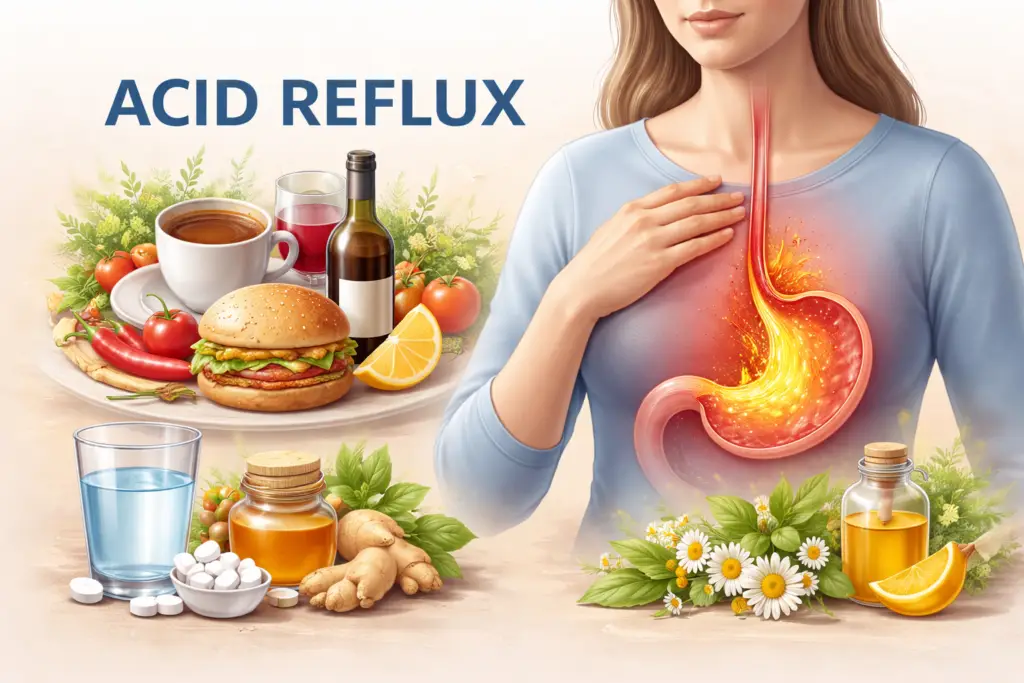
Your stomach is designed to hold acid. Your esophagus is not. The acid in your stomach starts pre-digestion and acts an important barrier to the outside world. Many bacteria are killed in stomach acid, preventing infection. Reflux happens when the lower esophageal sphincter (LES)—a ring of muscle that acts like a valve—relaxes or weakens, allowing stomach contents to move upward into the esophagus. That back-flow of acid up into your esophagus is what causes symptoms.
Reference: Gastroenterology review: https://www.gastrojournal.org/article/S0016-5085(17)36248-0/fulltext
So the issue is often acid in the wrong place, not necessarily “too much acid.” Reflux is usually about valve function and back-flow, not acid overproduction.
Is Reflux Caused by Too Little Stomach Acid?
You may have seen claims that heartburn is caused by low stomach acid (hypochlorhydria). The theory suggests low acid leads to poor digestion, gas buildup, and pressure that pushes contents upward. Here’s what we know:
- GERD is best explained by reflux mechanics (LES relaxation, hiatal hernia, pressure), not low acid as the primary cause. This is currenty up for debate and many doctors are suggesting that acid reflux is indeed a symptom of low acid, not high acid. More will be discovered about this in time and perhaps we will discover that we have been treating acid reflux the wrong way for years. For now, I review the information that is available, the published papers, the doctors on YouTube, etc.
Reference: Gastroenterology review: https://www.gastrojournal.org/article/S0016-5085(17)36248-0/fulltext
- Acid-reducing medications often relieve symptoms in many patients, which would be unlikely if low acid were the main issue. Here is the kicker. Acid reducers do indeed reduce acid reflux symptoms in people, BUT, perhaps they are treating the symptom and not the cause of the reflux. Why should you care? A bad analogy here is this. If you have water in your basement you can fix the problem. First, you can shut the water off. Problem solved, right? Not really, you need water. So, shutting the water off is like taking an acid reducer. It helps the reflux but not for the reason you might think. The other option is to find the problem and fix the problem. For example, you can find the broken pipe in your house and turn the water back on.
Reference: AGA Clinical Practice Update: https://pmc.ncbi.nlm.nih.gov/articles/PMC8754510/
That said, low stomach acid is real and can cause digestive discomfort—but it’s not strongly supported as a primary cause of GERD. I will post a pod cast link below that discusses the link between low stomach acid and GERD.
Could H. pylori Be Involved?
H. pylori is a bacteria that can infect the stomach lining. It is known to cause ulcers and chronic gastritis.
Reference: ACG Guideline: https://pubmed.ncbi.nlm.nih.gov/39626064/
Its relationship with reflux is complicated. Some studies show H. pylori infection may actually lower acid production in some patterns of infection. Eradicating it has, in some studies, slightly increased reflux symptoms in certain populations.
Reference: Meta-analysis: https://pubmed.ncbi.nlm.nih.gov/34437710/
In other words:
- H. pylori is not a simple cause of reflux.
- H. pylori can cause upper digestive symptoms—but it is not a straightforward cause of GERD.
An H. Pylori infection can cause many symptoms. Speak to your doctor and do your own research about the role of H. Pylori.
I recently had a bad flare up of acid reflux. It was so bad that it caused pain in my upper back. Apparently, the stomach and back share common nerves and this can cause a burning sensation in your back. I went to the emergency room because I was concerned it was my heart. It was not my heart. I suspected more than GERD. I suspected an infection. I did follow up with my doctor and got an upper endoscopy. The results were not bad. He did not find ulcers or a terrible looking esophagus. I have to wait for the bacteria cultures to come back. Meanwhile, I did my own research and found mastic gum!
Mastic Gum and H. pylori
Mastic gum (from Pistacia lentiscus) has been studied for antibacterial activity against H. pylori. A randomized pilot study found some effect—but it did not match standard medical eradication therapy. This means that the mastic gum helped but it done match the same effectiveness as the standard treatment of antibiotics for H. pylori.
Reference: Study: https://pubmed.ncbi.nlm.nih.gov/19879118/
It may have mild antimicrobial properties, but it is not currently guideline-recommended as a standalone treatment. Yet, I bought some and took it. I bought the capsules and emptied two capsuled into water. Perhaps this is coincidence, but my symptoms improved by 95%.
Check out my suggested products at the end of the article.
In short:
- Mastic gum shows some antibacterial activity in research, but it is not equivalent to standard medical treatment for H. pylori.
Practical, Evidence-Based Lifestyle Steps
These are consistently supported in clinical guidelines:
- Avoid Eating 2–3 Hours Before Bed
- Reduces nighttime reflux exposure.
Reference: AGA Guidance: https://pmc.ncbi.nlm.nih.gov/articles/PMC8754510/
- Elevate the Head of the Bed
- Use bed risers or a wedge pillow.
Reference: AGA Guidance: https://gastro.org/clinical-guidance/management-of-gastroesophageal-reflux-disease-gerd/
- Sleep on Your Left Side. Research shows left-side sleeping reduces nighttime acid exposure due to stomach anatomy.
REference: Study: https://pmc.ncbi.nlm.nih.gov/articles/PMC10643078/
- Reduce Caffeine (If It Triggers You). Evidence varies by individual, but caffeine may relax the LES in some people. I noticed that this is a major trigger for me.
Reference: AGA Guidance: https://pmc.ncbi.nlm.nih.gov/articles/PMC8754510/
- Weight Management. Weight loss has strong evidence for improving reflux symptoms. This has not been true for me. I am a healthy weight and it has not changed my GERD or sleep apnea. Both of these conditions are linked with being overweight.
Reference: AGA Guidance: https://pmc.ncbi.nlm.nih.gov/articles/PMC8754510/
Natural & Traditional Approaches (You can click on the link for the natural product or see the list at the end of the blog.
Folk & Traditional Western Remedies
- Ginger. Used for digestive comfort; may improve gastric emptying. Ginger has a long history of use as a stomach aid.
Reference: Study: https://pubmed.ncbi.nlm.nih.gov/21478660/
- Deglycyrrhizinated Licorice (DGL). Studied for mucosal soothing effects. DGL licorice is safer to consume than standard licorice root.
Reference: Review: https://pubmed.ncbi.nlm.nih.gov/19152565/
- Apple Cider Vinegar. Apple cider vinegar is sometimes used as a home remedy for reflux under the theory that symptoms stem from low stomach acid. However, current medical literature identifies reflux primarily as a mechanical issue involving the lower esophageal sphincter rather than insufficient acid production. There are no large clinical trials demonstrating that apple cider vinegar treats GERD, and in some individuals, it may worsen symptoms.
Ayurvedic Approaches
Ayurveda often associates reflux-like symptoms with excess “Pitta.” Find more information here if you are interested.
Common herbs include:
- Amla (Emblica officinalis) – antioxidant properties
Referene: NIH database: https://pubmed.ncbi.nlm.nih.gov/23335530/
- Triphala – studied for digestive support
Reference: Study: https://pubmed.ncbi.nlm.nih.gov/24191137/
Homeopathic Approaches
Homeopathy treats reflux based on symptom patterns rather than diagnosis. Scientific support for homeopathy remains controversial and inconsistent. I will provide additional information here.
Reference: Systematic review: https://pubmed.ncbi.nlm.nih.gov/20402610/
Mastic Gum (Mediterranean Folk Use)
Traditionally used for stomach discomfort and ulcers. Modern studies show partial antibacterial activity against H. pylori.
Reference: https://pubmed.ncbi.nlm.nih.gov/19879118/
Some natural remedies show promising or supportive evidence, but most are adjunctive—not replacements for medical evaluation when needed. I found the natural approach to acid reflux to be very effective. Lifestyle changes, diet changes, and the correct herbs can be very effective at treating moderate acid reflux.
When to Seek Medical Evaluation
See a clinician if you experience:
- Trouble swallowing
- Unexplained weight loss
- Vomiting blood
- Black stools
- Persistent symptoms despite lifestyle changes
Final Perspective
Acid reflux is usually not about “too much acid.” It’s about where that acid goes. Low stomach acid is not well supported as the main cause of GERD but many doctors have the argument that low acid might be a cause of GERD. Your body is unique. Medical practice is moving toward a holistic, individual, and functional approach. To me, this means that the cause of you acid reflux might be unique to you. Listen to your body. Make the obvious changes and see if your acid reflux gets better. If it doesn’t, try a different approach.
H. pylori plays a complex role and should be tested—not guessed. As a scientist, not a doctor, I believe that natural remedies may support digestive comfort, but they work best alongside evidence-based lifestyle strategies.
The Summary
It appears as though popping Tums all day is not the correct answer. You need to make changes. First, see a doctor and get an upper endoscopy. Second, make the lifestyle changes. Third, take supplements that will help to calm and heal the lower esophagus and get your stomach acid cycle back to normal.
References
- Gastroenterology review on GERD pathophysiology: https://www.gastrojournal.org/article/S0016-5085(17)36248-0/fulltext
- AGA Clinical Practice Update on GERD management: https://pmc.ncbi.nlm.nih.gov/articles/PMC8754510/
- ACG Guideline on H. pylori: https://pubmed.ncbi.nlm.nih.gov/39626064/
- Meta-analysis on H. pylori and GERD: https://pubmed.ncbi.nlm.nih.gov/34437710/
- Mastic gum study: https://pubmed.ncbi.nlm.nih.gov/19879118/
- Left-side sleeping study: https://pmc.ncbi.nlm.nih.gov/articles/PMC10643078/
- Ginger and gastric emptying: https://pubmed.ncbi.nlm.nih.gov/21478660/
- DGL licorice review: https://pubmed.ncbi.nlm.nih.gov/19152565/
- Amla research: https://pubmed.ncbi.nlm.nih.gov/23335530/
- Triphala research: https://pubmed.ncbi.nlm.nih.gov/24191137/
- Homeopathy systematic review: https://pubmed.ncbi.nlm.nih.gov/20402610/