
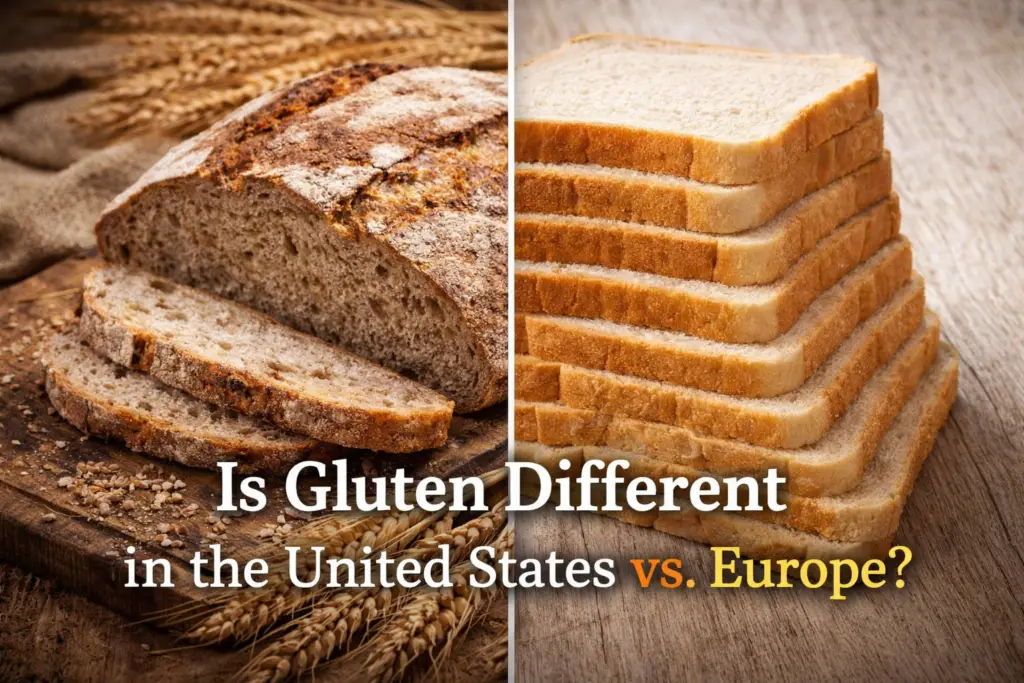
Is Gluten Different in the United States vs. Europe?
Why Some People Tolerate European Bread but Not American Bread
I have heard, anecdotally, that many travelers report a curious experience: they struggle with bread or pasta in the United States but seem able to eat wheat products comfortably when traveling in Europe. This observation has fueled a common belief that gluten in Europe is somehow “different.” Perhaps the U.S. is doing something to the gluten? Genetically modifying the gluten producing gene to make it stronger? Adding toxins to the wheat?
The reality is more complicated. Scientific evidence suggests that gluten itself is largely the same worldwide, but differences in wheat varieties, bread fermentation methods, and food processing practices may influence how people experience wheat products.
Understanding this issue requires examining both the biology of gluten and the modern food system that surrounds it.
What Gluten Actually Is
Gluten is not a single molecule but a complex mixture of proteins found in wheat, barley, and rye. The two main components—gliadin and glutenin—combine to form a network that gives bread dough elasticity and structure [1].
These proteins are unusually rich in the amino acids proline and glutamine, which makes them difficult for human digestive enzymes to fully break down [1].
For most people, this is harmless. However, in individuals with celiac disease, fragments of gliadin trigger an autoimmune reaction that damages the small intestine.
Gastroenterologist Dr. Alessio Fasano, one of the world’s leading celiac researchers, explains:
“Gluten is one of the most complex proteins we consume, and in susceptible individuals it can activate the immune system in ways that lead to intestinal inflammation.” [2]
Wheat Varieties Are Different
One meaningful difference between Europe and the United States involves the types of wheat commonly grown.
American wheat production often focuses on hard red wheat, which contains relatively high protein levels and produces strong gluten networks ideal for industrial bread production [3].
European agriculture frequently relies more heavily on soft wheat and durum wheat, which typically produce somewhat weaker gluten structures [3].
Because gluten strength correlates with protein levels, this difference may influence how wheat products behave during digestion.
However, research examining wheat breeding trends suggests that modern wheat varieties do not contain significantly more gluten than historical varieties. A major analysis of wheat breeding data found that gluten concentrations have not substantially increased over the past century [4].
Food scientist Donald Kasarda, formerly with the U.S. Department of Agriculture, summarized the evidence:
“The idea that modern wheat contains dramatically higher gluten levels than older varieties is not supported by available data.” [4]
Bread Fermentation May Matter More Than Wheat
The most significant difference between European and American wheat products may be how bread is made.
Traditional European baking often relies on slow fermentation techniques, including sourdough fermentation. During long fermentation, microorganisms break down gluten and other complex carbohydrates.
Research has shown that fermentation can reduce certain wheat compounds that trigger digestive symptoms, including fructans, a type of fermentable carbohydrate [5].
Food microbiologist Marco Gobbetti, a leading expert in sourdough fermentation, notes:
“Long fermentation allows enzymes and bacteria to partially degrade gluten and other compounds in wheat, which may improve digestibility for some individuals.” [6]
By contrast, much of the industrial bread production in the United States uses rapid fermentation methods designed for efficiency and consistency.
These faster processes may leave more intact gluten proteins and fermentable carbohydrates in the final product.
It May Not Be Gluten at All
In recent years, scientists have discovered that many individuals who believe they are sensitive to gluten may actually be reacting to other components in wheat.
These include:
• Fructans, a type of FODMAP carbohydrate
• Amylase-trypsin inhibitors (ATIs)
• Other wheat proteins that activate immune responses
Studies suggest that fructans may be responsible for digestive symptoms in many cases of so-called “non-celiac gluten sensitivity” [7].
Gastroenterologist Dr. Peter Gibson, a pioneer of FODMAP research, explains:
“Many people who believe they have gluten sensitivity may actually be reacting to poorly absorbed carbohydrates such as fructans.” [7]
Why the Experience Feels Different
Although gluten proteins are essentially the same worldwide, several factors may contribute to the perception that European wheat is easier to tolerate:
1. Traditional fermentation methods
Slow fermentation can partially break down gluten and fermentable carbohydrates.
2. Different wheat varieties
European wheat varieties often produce weaker gluten structures.
3. Less ultra-processed bread
Artisan bread traditions remain common in many regions.
4. Dietary patterns
Meals in Europe may contain fewer ultra-processed foods overall.
5. Lifestyle factors
Travel often involves slower meals, more walking, and lower stress levels.
All of these factors can influence digestion.
The Bigger Picture
Scientific evidence suggests that gluten itself is not fundamentally different between the United States and Europe. However, the broader food system surrounding wheat—agriculture, processing, fermentation, and dietary patterns—may influence how wheat products affect the body.
In other words, the story is not simply about gluten. It is about how modern food systems interact with human biology.
Read the Other Articles in this Series
In this first article, “Gluten: What’s the Story?” I raised a few important questions and offer some ideas to think about.
In the second article, “Why Some People Tolerate Gluten in Europe but Not in the United States,” we will look at the science of gluten itself and explore possible explanations for why some people report different reactions depending on where they eat wheat products.
In the third article, “Gluten, Zonulin, and the ‘Leaky Gut’ Hypothesis: Why Gluten Triggers Autoimmune Disease in Some People,” we will look at a biological mechanism that may help explain why gluten causes inflammation in some individuals but not in others.
In the fourth article, “What Can Be Done to Reduce Zonulin and Support the Gut Barrier,” we will look at some practical recommendations for people who want to address some of the concerns raised in this series.
In the fifth article, “Gluten Sensitivity Test: How Do You Know If Gluten Is Affecting You?” we will look at how you can determine if you have a gluten sensitivity beyond celiac disease
References
- Wieser, H. (2007). Chemistry of gluten proteins. Food Microbiology.
- Fasano, A. (2020). Celiac disease and gluten sensitivity. New England Journal of Medicine.
- Shewry, P. & Hey, S. (2015). The contribution of wheat to human diet. Food and Energy Security.
- Kasarda, D. (2013). Can an increase in celiac disease be attributed to an increase in gluten content of wheat? Journal of Agricultural and Food Chemistry.
- Struyf, N. et al. (2017). Fructans in wheat products and their reduction during fermentation. Journal of Cereal Science.
- Gobbetti, M., De Angelis, M., & Di Cagno, R. (2014). Sourdough fermentation and nutritional benefits. Food Microbiology.
- Gibson, P. & Shepherd, S. (2010). Evidence-based dietary management of IBS: The FODMAP approach. Journal of Gastroenterology.


Pingback: Gluten: What Is It Doing in the Body?